Amazing Low-Price Flats in Dhaka – Mind-Blowing Deals (Property Studio Guide)
Category: Real Estate
By: Property Studio Team
Focus: Property Buy in Dhaka
Finding a low-price flat in Dhaka?
You’re scrolling through listings, and the numbers start feeling personal. Another ৳২০,০০০+ for a “box” that barely fits a family? Seriously?
Here’s the truth: finding a low-price flat in Dhaka isn’t impossible—but most people search in the same crowded places, at the wrong time, with the wrong checklist.
This guide is built for budget buyers who want real value (not just a low sticker price). And because Property Studio is all about keeping properties organized and documented, we’ll also show how to track, compare, verify, and protect your purchase like a pro.
Table of Contents
- Finding a low price flats in Dhaka?
- Understanding Dhaka’s Budget-Friendly Housing Market
- Current real estate trends in Dhaka
- Price ranges for affordable flats
- Most economical neighborhoods
- Factors affecting flat prices
- Top Areas for Low-Price Flats in Dhaka
- Mirpur: The budget-friendly haven
- Uttara: Affordable modern living
- Mohammadpur: Value for money
- Badda and Rampura: Emerging affordable areas
- Keraniganj: The outskirts advantage
- How to Find the Best Deals on Flats
- Online real estate platforms
- Working with budget-focused agents
- Developer direct purchases
- Government housing schemes
- What to Expect in Budget Flats
- Typical sizes and layouts
- Standard amenities and facilities
- Construction quality considerations
- Age of building vs. price correlation
- Financial Options for Purchasing Affordable Flats
- Bank loans with favorable terms
- Developer payment plans
- Government subsidies and programs
- Cooperative housing options
- Red Flags to Watch When Buying Low-Price Flats
- Hidden costs and fees
- Legal documentation issues
- Infrastructure and utility concerns
- Security and accessibility challenges
- Future resale value considerations
What you’ll get from this post
Over the last three years of searching affordable options across Dhaka—from Mirpur to Badda—we’ve noticed something consistent:
The best deals often never appear on the “mainstream” channels the way premium properties do.
By the end of this guide, you’ll know:
- which areas usually deliver the best value,
- when to search for better pricing,
- and negotiation techniques that often help buyers reduce costs—sometimes up to ~15% on the agreed rental/purchase terms when done correctly.
But first—let’s address the most expensive mistake budget flat hunters make…
Understanding Dhaka’s Budget-Friendly Housing Market
(Image concept prompt)
Create a realistic image of a modern, modest apartment building in Dhaka with a “Budget Flats Available” sign, Dhaka skyline in the background, a middle-aged Bangladeshi male real estate agent pointing at an affordable housing complex, simple price charts visible in the foreground, bright daytime lighting, showcasing an accessible housing market.
Current real estate trends in Dhaka
Dhaka’s housing market is changing. Developers are finally recognizing that buyers aren’t all “crore-level” customers. That’s why we’re seeing more:
- compact units (studio/1-bed)
- “small but usable” layouts
- projects expanding into outer zones where land is cheaper
The pandemic pressure accelerated this shift. Costs went up, yes—but many builders adjusted with smaller units and leaner specs to keep prices within reach.
Another noticeable shift: more projects are launching outside the prime zones, offering opportunities for people who can accept a slightly longer commute in exchange for a lower price.
Price ranges for affordable flats
Here’s a practical snapshot of what “budget-friendly” often looks like:
Area Size
Price Range (BDT)
Location Type
600-800 sq ft
25-35 lakh
Far suburbs
800-1000 sq ft
35-50 lakh
Developing areas
600-800 sq ft
45-60 lakh
Mid-range locations
For many buyers, the “value zone” is often around 800 sq ft in a developing area that’s not too far from key roads or hubs. Prices rise sharply as you move closer to premium neighborhoods like Gulshan / Banani / Dhanmondi.
Most economical neighborhoods
If you want better value without burning your budget, these areas frequently come up:
- Mirpur (especially sections 10, 11, 12 for balanced value)
- Uttara (newer sectors—15 to 18—still have options, but prices are climbing)
- Mohammadpur (solid middle-income choice with strong location advantage)
- Keraniganj / Demra (outside core Dhaka—often cheaper with bigger space potential)
Factors affecting flat prices
Flat pricing in Dhaka is shaped by a few consistent forces:
- Location still dominates—every step closer to Gulshan/Banani adds a premium.
- Size matters, but price per sq ft varies more by area than by room count.
- Building age impacts pricing heavily (newer = higher; older = cheaper).
- Connectivity changes everything—properties near major links (including metro routes) often see faster price jumps.
- Amenities (lift, generator, security, parking) push prices up, even in “budget” projects.
Top Areas for Low-Price Flats in Dhaka
(Image concept prompt)
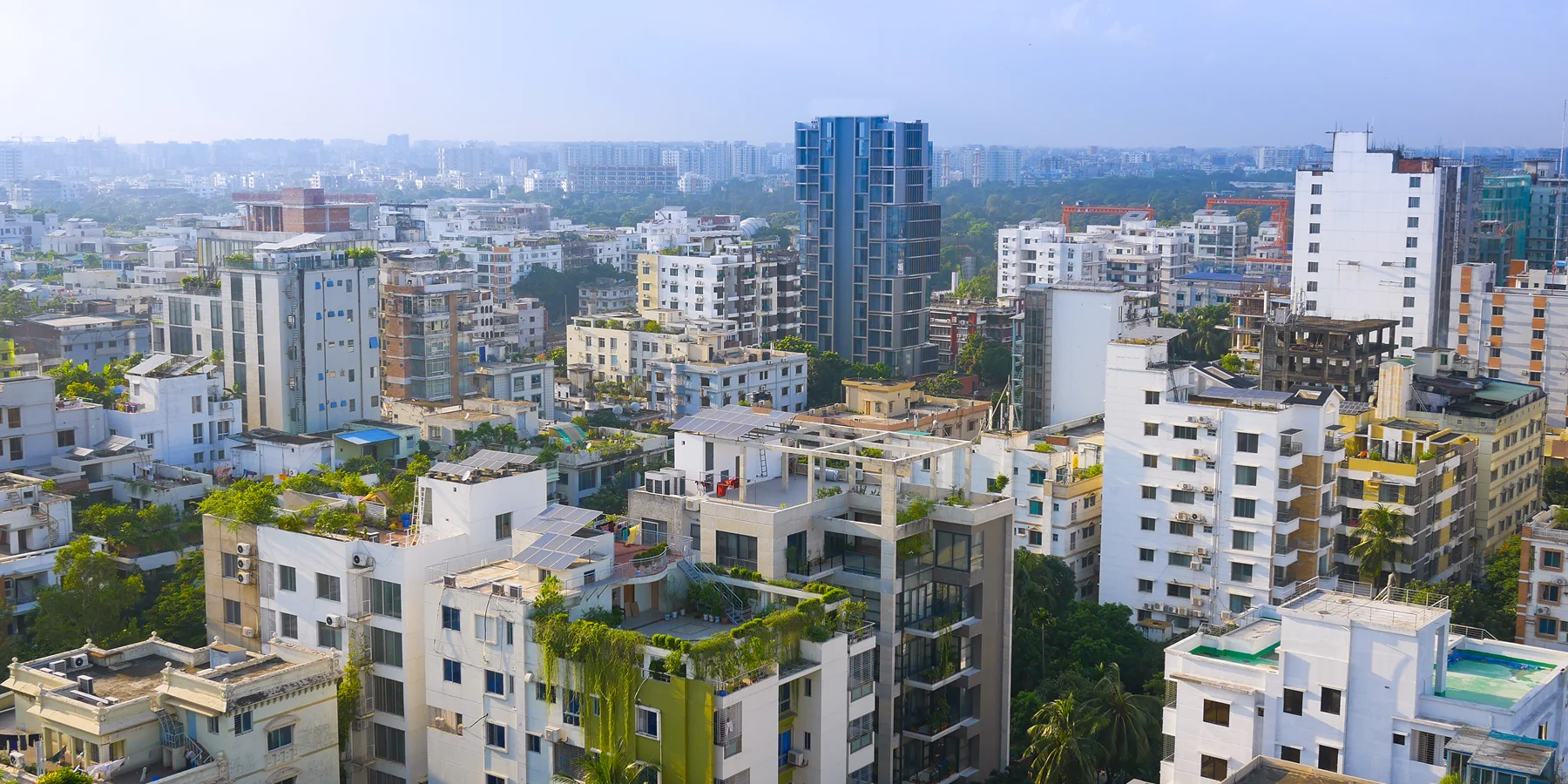
Create a realistic panoramic view of Dhaka skyline showing modest apartment buildings in developing neighborhoods, visible banners indicating affordable rates, a small corner map highlighting Mirpur, Mohammadpur, and Uttara, daylight over the city, and a few buildings under construction in the background.
Mirpur: The budget-friendly haven
If you’re shopping with a strict budget, Mirpur is often the first serious stop.
Why? Because it’s huge, diverse, and offers different pricing pockets across sections. Generally:
- sections 11 and 12 tend to be newer/more upgraded
- sections 6 and 7 can be more budget-friendly
A common price expectation:
~30–45 lakh for a 1000 sq ft unit (depending on exact section, road width, lift/generator, and finishing).
Infrastructure has also improved significantly, and transport connectivity has become a major advantage for many families.
Uttara: Affordable modern living
Uttara offers a more organized “planned town” vibe compared to many parts of Dhaka.
- Newer sectors (often 10–18) can provide decent value
- Pricing might be around 45–60 lakh for ~1200 sq ft in many cases
Big plus points:
- schools, hospitals, shopping
- airport proximity
- more planned roads
But prices here can rise quickly—so comparing multiple options matters.
Mohammadpur: Value for money
Mohammadpur sits in a sweet zone: central access without fully premium pricing.
You’ll find both busy and quieter pockets:
- from bustling zones like Beribadh
- to calmer areas like Iqbal Road
Typical expectation:
~35–50 lakh for 1000 sq ft (varies by road access, building quality, and parking).
The biggest win is connectivity to Dhanmondi, Farmgate, Mirpur without paying those top premiums.
Badda & Rampura: Emerging affordable areas
Buyers looking for “value close to the center” are increasingly exploring Badda and Rampura.
What changed? Connectivity improvements made these areas more practical—but pricing hasn’t always “caught up” fully, which creates opportunity.
Typical range:
- Badda (Middle/South): 40–55 lakh for ~1000 sq ft new builds
- Rampura: similar pricing, with stronger deals slightly away from main roads
Keraniganj: The outskirts advantage
If you can live slightly outside the main city zones, Keraniganj can be one of the highest “space-for-money” areas in the broader Dhaka region.
Common deal patterns:
- 25–35 lakh for ~1000 sq ft
- newer projects with parking, generator, and sometimes small parks
Many buyers also like:
- more open space
- often better air compared to dense inner city areas
- larger layouts for the same money
How to Find the Best Deals on Flats
(Image concept prompt)
Create a realistic image of a Bengali man in his 30s checking apartment listings on his smartphone while standing in front of affordable apartment buildings in Dhaka, low price tags visible, daylight, hopeful vibe for budget flat hunters.
Online real estate platforms
Budget hunting is much easier now thanks to platforms like Bikroy, BProperty, and bti.
Use:
- price filters
- area filters
- amenity filters (lift, parking, generator)
Property Studio tip: Don’t just view—compare and document. Keep a record of:
- asking price vs negotiated price
- amenities included
- maintenance cost promises
- papers promised
Also: message owners directly. Many negotiate more if a listing has been sitting for a while.
Working with budget-focused agents
Some agents specialize in budget properties and “hidden inventory” that never gets posted online.
How to find a good one:
- ask friends who bought within your budget range
- choose agents who ask you clear questions (budget, must-haves, no-go zones)
- avoid agents who repeatedly show properties above your ceiling
Be direct about your max price, but respect their time too.
Developer direct purchases
Going directly to developers can reduce cost, especially during:
- pre-construction launches
- early booking stages
Potential benefit:
- sometimes 10–15% lower than market
- better unit selection early
- value appreciation by handover time
Well-known names may periodically offer budget-oriented projects—get on their update lists when possible.
Government housing schemes
Programs under the National Housing Authority / RAJUK sometimes offer more affordable projects, often with application-based selection.
These can be meaningfully cheaper than market prices, but:
- paperwork and eligibility rules can be strict
- competition can be high
- deadlines matter
Keep an eye on official announcements and prepare documents early.
What to Expect in Budget Flats
(Image concept prompt)
Create a realistic interior of a modest but clean flat in Dhaka: small living room, simple furniture, basic amenities, slightly worn white walls, ceiling fan, natural light through windows, realistic look showing what budget-conscious buyers can expect.
Typical sizes and layouts
Budget flats commonly fall around 700–1200 sq ft.
Typical formats:
- 2-bedroom or 3-bedroom
- combined living + dining
- compact kitchen
- 2 bathrooms for many 3-bed layouts
- limited balcony space (or none)
Many follow a similar footprint:
- entrance → living room
- bedrooms lined on one side
- kitchen in the back
- tight circulation space
Standard amenities and facilities
You may not get luxury, but basic items often appear:
Usually included
- water supply (often reserve tanks)
- electricity connection (sometimes generator backup)
- basic security (guard/caretaker)
- shared/limited parking
- tiled flooring
- basic bathroom fittings
Usually NOT included
- gym / pool
- central AC
- rooftop garden
- premium lifts (and often no lift under 6 stories)
- guaranteed high-speed internet setup
Construction quality considerations
Budget buildings vary hugely. Check:
- wall finishing (cracks/dampness)
- wiring (exposed wiring = red flag)
- plumbing (leaks + water pressure)
- doors/windows (poor fitting affects security and comfort)
A fresh coat of paint can hide problems—inspect carefully.
Age of building vs price correlation
Age strongly influences pricing in Dhaka:
- 0–5 years: usually priced higher, even in budget zones
- 5–10 years: often the best value balance
- 15+ years: usually 20–30% cheaper but may require upgrades/repairs
The common “value sweet spot” is often 7–8 years in a developing area—decent depreciation without extreme maintenance risk.
Financial Options for Purchasing Affordable Flats
(Image concept prompt)
Create a realistic scene of a Bangladeshi family reviewing financial papers and housing brochures at a dining table, calculator, loan options on paper, laptop showing affordable flat listings, natural light, hopeful budget homebuyer vibe.
Bank loans with favorable terms
Many banks offer home loans designed for buyers who need manageable monthly payments.
Common benefits:
- long repayment tenures (often 15–25 years)
- financing up to ~80% in many cases (depends on eligibility)
- “first-time buyer” packages exist in the market with fee reductions/simplified steps in some cases
Always compare:
- interest method
- processing fees
- early settlement conditions
- required documentation
Developer payment plans
Developers often offer installment structures such as:
- 30–40% upfront
- remaining paid monthly over 3–5 years
Some offer milestone-based payments (pay as construction progresses), which can feel safer for buyers.
You may also see “rent-to-own style” ideas in the market—read the terms carefully.
Government subsidies and programs
There are housing-focused programs intended to support lower/middle-income families, sometimes offering lower-interest loans and scheme-based allocation.
These can be valuable, but:
- eligibility and paperwork can be strict
- availability can vary
- timelines can be slow
Cooperative housing options
Housing cooperatives can reduce costs because the group builds collectively, reducing developer profit layers.
Benefits:
- pooled buying power
- flexible payment styles
- some cooperatives partner with employers for salary-based payment arrangements
But verify governance rules and legal structure before committing.
Red Flags to Watch When Buying Low-Price Flats
(Image concept prompt)
Create a realistic scene of a South Asian male inspecting a low-price flat in Dhaka with visible issues: wall cracks, water stains, exposed wiring. A nervous agent nearby. Dim interior light, Dhaka city view through window. Cautionary mood.
Hidden costs and fees
The “cheap flat” can become expensive once extras appear.
Common surprise costs:
- building maintenance fees (can become meaningful annually)
- “utility development charges” (water/gas line, connections, etc.)
- registration-related expenses
- parking cost (often not included)
Parking can add a lot in many buildings, or you’ll live with daily parking stress.
Legal documentation issues
Many buyers get trapped by paperwork shortcuts.
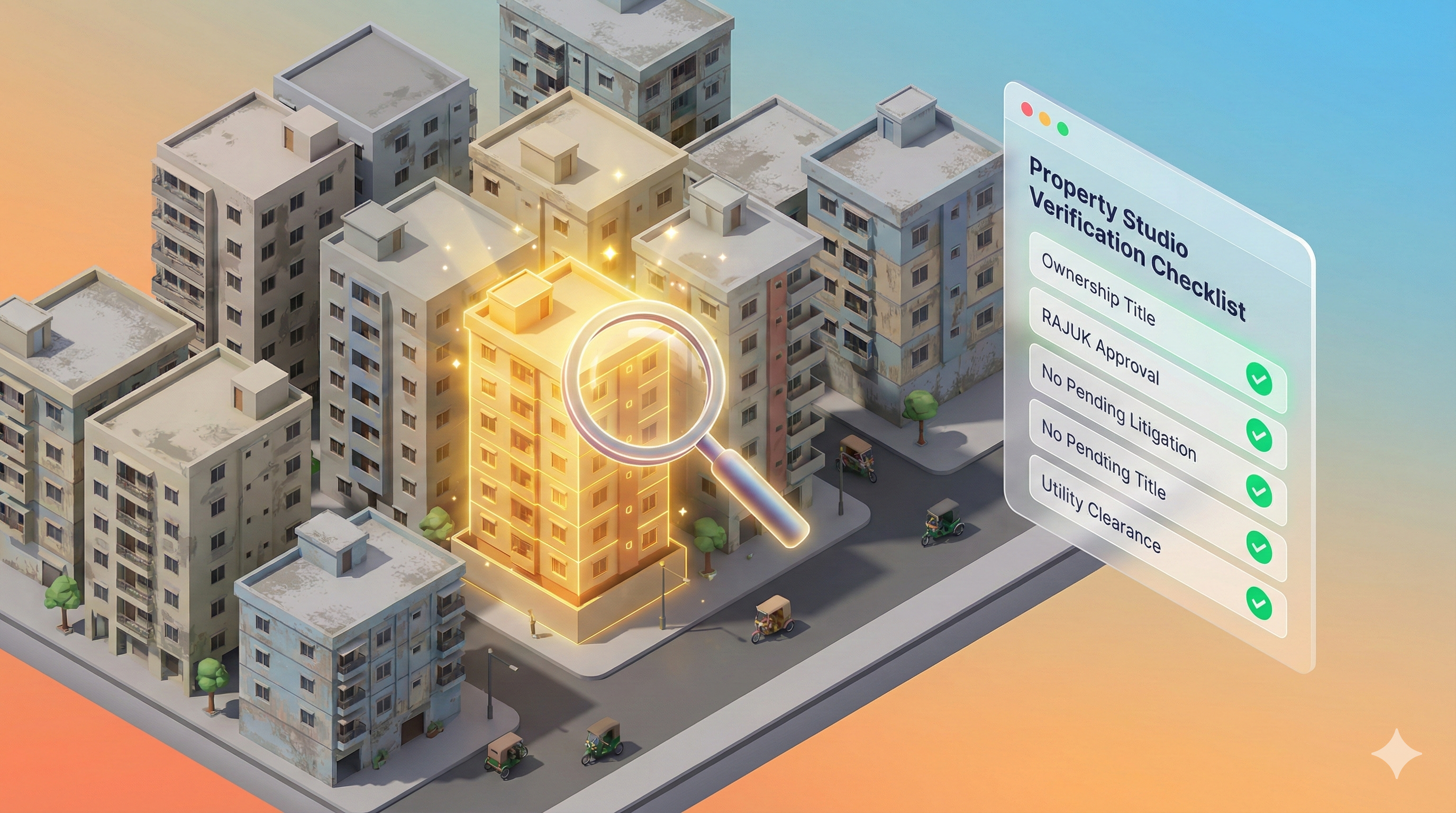
Watch for:
- disputed land
- missing approvals
- incomplete documentation chain
- messy power-of-attorney transfers (multiple transfers can become a legal headache)
Property Studio mindset: If it’s not verifiable, don’t treat it as true.
Infrastructure and utility concerns
In budget buildings, utilities often reveal the reality:
- poor pipe quality → frequent leaks + damage
- low electrical capacity → cannot handle AC + appliances together
- water supply promises that don’t match reality → need tanks/pumps
- lifts that break often + surprise “maintenance collection” requests
Security and accessibility challenges
Budget buildings often reduce security spending:
- untrained guards/caretakers
- CCTV systems that work “sometimes” (and fail in outages)
- weak fire safety planning (blocked exits, expired extinguishers)
Road access matters too:
- narrow roads
- flooding in monsoon
- difficult vehicle entry/exit
Future resale value considerations
Some “cheap” flats keep dropping in relative value if:
- construction quality is poor
- building maintenance fund is weak/nonexistent
- the area’s future development hurts livability (factory, terminal, etc.)
- the building becomes renter-heavy and deteriorates faster
A building’s long-term upkeep culture affects resale more than buyers expect.
Best time of year to search (and why it matters)
Timing can improve your leverage:
- End of month / end of quarter: sellers and agents often want closure
- Off-peak seasons: when fewer buyers are actively searching, negotiation becomes easier
- Long-listed properties: listings sitting too long usually have wiggle room
Negotiation tactics that regularly work
- Don’t negotiate only the price—negotiate parking, utility charges, and handover fixes
- Ask for a written list of included items (generator coverage, lift, guard, water system)
- Use comparisons: “This building offers X at this price—match it or adjust”
- Be ready to walk away: the best discounts appear when sellers feel you’re not desperate
Many buyers reduce their cost meaningfully—sometimes around ~15% depending on urgency and how long the unit has been listed.
Final thoughts (Property Studio angle)
Finding an affordable flat in Dhaka doesn’t have to feel impossible. When you focus on value areas, use smart search channels, understand realistic amenities, and verify paperwork—budget homeownership becomes achievable.
And after you buy, staying organized is how you protect your investment long-term. With Property Studio, you can keep everything documented:
- property records & expenses
- tenant/rent tracking (if you rent it out)
- maintenance history
- receipts and building communication
Start your search, stay smart, and make the purchase you won’t regret.
Expert insights from the Property Studio team on property management, real estate, and digital solutions.